Showing posts with label sewing. Show all posts

Wednesday, April 29, 2015

Teeny tiny ribbon roses!

Don't tell anyone...I should be working on my thesis right now! But procrastinating writing can be exhausting, so I needed a break from finding excuses to take breaks from work ;) Plus, this post has been in the works for almost a week, so it's time to set it free!

So here's my tutorial for making tiny ribbon roses, which I need for a little project I'll share in a later post. I sought high and low online and didn't quite find what I wanted, so I kind of cobbled a hybrid from tutorials from Ravings of a Mad Crafter and Solo Un Tip. (Just giving credit where it's due.) Enjoy!


Materials

  • thread
  • cloth onto which you will build the rose: I found felt to be a great material, but you can also use organza, or a bulky fabric that is easy to make large holes in.
(I am using contrasting colors in my materials here so it's easier for you to see, but you will most likely want to use the same color of ribbon and thread.)

Part 1: Make the star-shaped frame


1. Cut a 10" piece of each width of ribbon, at an angle so it'll be easier to... 2. Thread each ribbon through a needle. 3. Pull the thin ribbon through the fabric:

4. On the back side, tie a simple knot so it stays put:

5. Flip the fabric over. Sew the ribbon back to the other side by making what will be the center of the rose, so that you have a stitch that is roughly 1/2" long. It will look like this; you are looking at the front side of the fabric where the rose will end up:

6. Use something like a ballpoint pen or dull pencil to make the center hole bigger:

7. Continue sewing the ribbon in and out until you form a 5-sided star. Each arm of the star should come out of that center hole. I found it best to go in this order (you're looking at the front here):


8. When you're done forming the last arm of the star, you can sew or glue down the end of the ribbon on the back side of the fabric:

Part 2: Form the rose

9. Insert the wider ribbon through the center hole of the frame until it peeks through. If you're having trouble, you can use a needle to pull it through:

10. Pull it all the way through. On the back side, make another knot to keep it in place:

11. Now the fun part! Twist the needle around several times:

12. Wind the part of the ribbon that is coming out of the frame into a tight little circle, and you'll find that the ribbon forms a nice little rose center all by itself:

13. Making sure the center stays put, take the needle under one of the arms in the frame and pull it all the way through:

14. Continue building the rose by making 1 or 2 twists in the ribbon, and pinning it down to an arm of the star. Skip everyone other arm as you go around so that the "petals" are big enough.
15. After about twice around, it'll look something like this:
Then this:
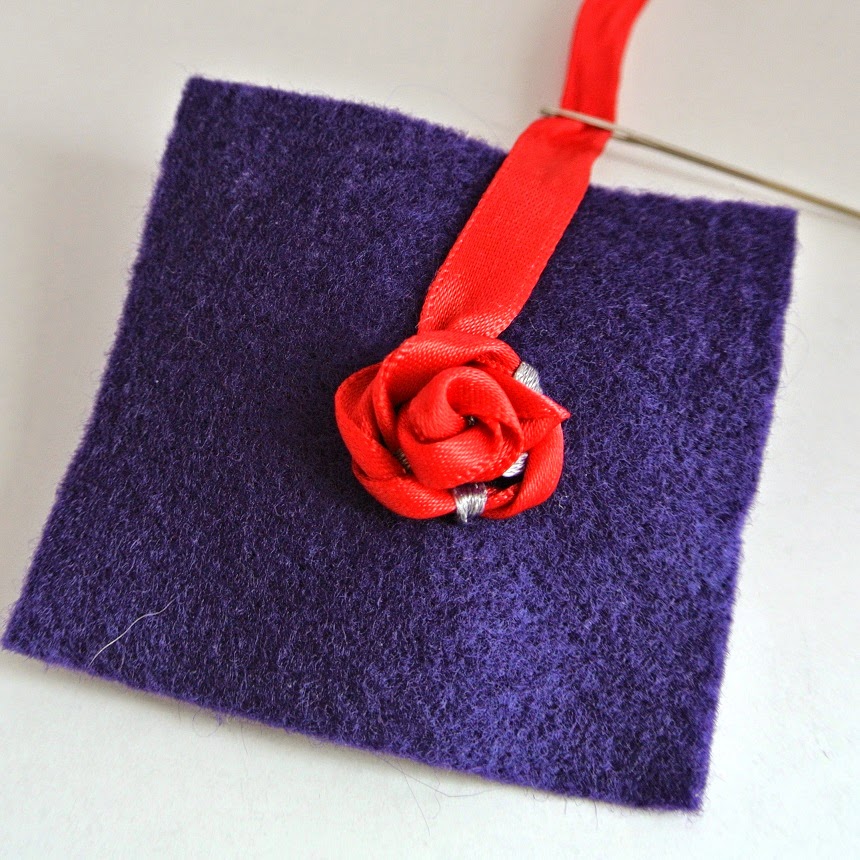
16. There are a couple of ways to finish this.  You could glue the end of the wide ribbon down with hot glue, but I chose here to sew it in place with a bit of thread again:

17. Trim your ribbon and step back to admire your work!

You can see the frame ribbon is already pretty well hidden here, but it looks great with matching colors:

I haven't tried it yet, but I'm sure this wouldn't be too hard to scale up using wider ribbon to make larger roses.


So I wrote most of this during our long flights when we took a trip to Boston this past weekend for a wedding, while our brother- and sister-in-law (bless them!) watched the little monsters. They couldn't be happier, especially because it means they had their big fluffy monster friend Blue to play with all weekend! Hope you all enjoyed your weekend as well...the next one isn't too far away now!!

 Follow

Saturday, January 17, 2015

Make a bedskirt from a flat sheet

TGISaturday! Could the weekend last forever? That would be awesome.  So I'm still catching up with my end-of-2014 projects before I start telling you guys about the new stuff I've been doing.  This might be the last one that I did last year, actually!  Well, I also have a monster paint-trimming post to write, but let's worry about that later...

The bed in our guest bedroom was skirt-less for a couple years.  Don't worry, it wasn't completely naked - I had an old fitted sheet on the boxspring.  Sorry, no "before" picture again :(  I'm still new at this, ok!  Just imagine the fitted sheet on the boxspring, and your basic metal mattress frame.

I was inspired by this great tutorial from Designer Trapped in a Lawyer's Body, since I had an old flat sheet in the linen closet that would match the colors I already had.  And if I had the patience to wait the 2 days for the upholstery pins to come in from Amazon, I would have followed it to a tee!  But I had to adapt so I could pull this off with my sewing machine. (Ha! So ironic: a no-sew project modified into a sewing project. Spurred on by impatience.)

First, I started by ironing the sheet on high heat and steam until it was perfectly smooth.  Then, I put it over the boxspring and puckered up excess width in the middle,
 so that the left and right edges fell to the right length to the floor:


That pucker in the middle becomes the pleat.  Iron it straight down the middle, and sew it in place.

Next, the corners.  After lots of fiddling and pinning in the wrong places, the following method worked for me.  First, pull out the corners nice and straight:


Then, pinch the outermost corner and lift it to the SIDE of the bed, and smooth everything out.  (The side that is facing you in the photo is the left side of the bed.)
Basically, the diagonal line you see cast in that photo above is where you are going to sew a seam. Pin it together.


To preview what the corner will look like at the end, bring that panel down to the floor:

This is what it will look like after you sew the seam:

 And ta-da! The finished product, with minimal sewing!  You could also choose to forgo the pleat in the middle, but then you'd have to trim an edge of the sheet, and that would result in more sewing.  And who wants that.


Ok so for our closing dose of cute, I decided that we should get a shot of the dogs in a bed, since we're talking about beds here.  And as it turns out, I do have a "before" picture, albeit not ideal, of the cover we were using for the dog crate I featured on my last post!  Another very important thing you should note is how Elba seems to think Casper makes an excellent pillow.

Sunday, January 11, 2015

Dog crate cover

Happy weekend, everyone!  Just sharing some pics of a cover I made for the crate that our dogs sleep in at night.  Did I take "before" photo?  Of course not.  That would be way too logical.  Suffice to say we used an old ugly beach towel thrown over the crate because we read somewhere that is supposed to create a more "den-like" environment.  Also, it's nice to block out some light if one of us is up and about early in the morning but we want to let them sleep more.  As if they don't do that enough during the day.

So there's the "after"!  Fabric is fleece from Jo-Ann's that was on sale.  They have so many cute prints, and it almost made me wish I had a Scottie so I could use a Scottie print they have ;)

I made a little flap that goes over the door so that they can really get their beauty rest without being bothered by light (so spoiled!):
You can also see in those pictures I also cut a little slit for the carrying handle to peek out.

I used pre-made double folded bias tape, also from Jo-Ann's, in a matching color for the edges of the door flap, and also the hem all the way around.  Tip: the wider the bias tape, the easier to work with, especially for bulky fabric like fleece - wish I had known before getting the skinniest one!

And matching piping for the vertical edges:

What do you guys think!? I think Casper and Elba like it, at least...

Sunday, March 9, 2014

Replacing coat pockets: your favorite pockets, guaranteed!

Thankfully, since hubby and I have been living in California for the past 5 or so years, we haven't had to deal with frigid winters - thank goodness!  But whether you're dealing with the polar vortex or just some foggy mornings in northern CA, there's nothing better than a toasty pocket.

I first did this with a winter coat when we lived in Boston.  For some reason, even nice heavy coats often come with a really thin crepe-y polyester lining that not only rips easily at the seams, but isn't very warmHand-sewing them back up is only a temporary fix.

Here's a quick project to permanently fix up thin coat pockets that have holes in them. (It took me about an hour, but am really.easily.distracted.  Especially if there are dogs on tv! And in your lap.)

For your replacement lining material, pick a fabric that is both durable and feels good against your hands. If you have a more fitted coat, pick a thinner fabric so you don't get bulky pockets that mess up your look.  For a coat that's heavy, you can go for thick fleece or even faux fur, and you will not ever want to take your hands out of your pockets. The one thing you don't need to worry about is how the material looks, because it will be hidden from view!  (That also means you can pretty much be as messy as you want to be with the stitches - lazy or inexperienced sewers rejoice.)

Here is the wool coat that will be my victim today, with its torn pocket innards displayed in dramatic fashion:

First, with a seam ripper or sharp scissors, separate the lining from the outer fabric at the front bottom corner under the pocket:
 You just need a slit wide enough so you can access the pocket and pull it out from the bottom.  Then, go to town and start ripping the seams that hold the pocket to the edge of the outer coat material...

...on both sides of the pocket. If you're going to be replacing both pockets, only take apart one at a time so you can use the other for reference in case you get lost in putting things back together.

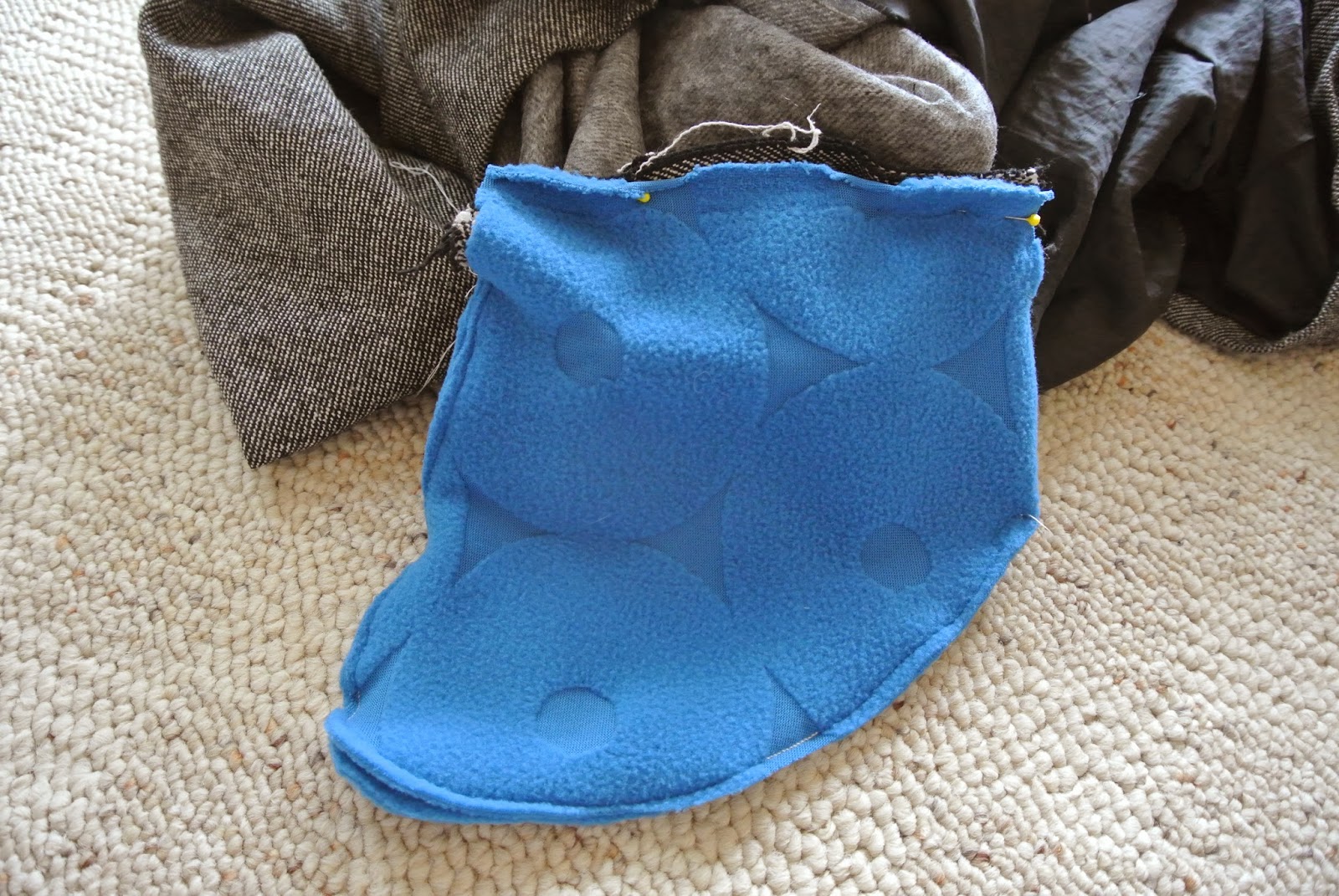
So, now that you have your old pocket freed, you can use it as a pattern for your new pocket!  For this coat I used a thin fleece fabric. (Please don't tell anyone it's from Ikea's fabric aisle, but I happened to already be there and it saved me from a trip to the fabric store.)
 You can cut the two sides of the pocket separately, or just fold the fabric over like I did so you're spared from a tiny bit of sewing.  And, you can make your new pockets deep so you can store even more crap in them!


Ok so now pocket transplant part 2: match the new pocket edges back up to the coat, and pin it in place.  Make sure that everything lies flat, so you don't get that bulkiness I mentioned earlier.  Carefully (so you don't pin yourself like I always manage to do) tuck the pocket back into the coat before you sew everything up just to make sure it falls into place. When you're satisfied, pull the pocket back out from the bottom of the coat and sew up everything you pinned.
I used my sewing machine to zip through sewing the edges, and then finished up the tight corners with hand sewing.

And there you go! With your new toasty pockets hopefully you're gonna face the chill feeling like this: